
TABLE OF CONTENTS
1. Purpose of Simulations
The simulation capability in the Insights Platform enables you to test hypothetical scenarios and forecast potential outcomes. Rather than waiting for changes to play out in the real world, you can model them in advance to guide strategic decisions.
Typical questions simulations can answer include:
- What if we increase digital media spend by 15%?
- What happens if we stop advertising in one channel for a quarter?
- What would be the impact of adjusting product pricing or running an additional promotion?
2. The Simulation Process
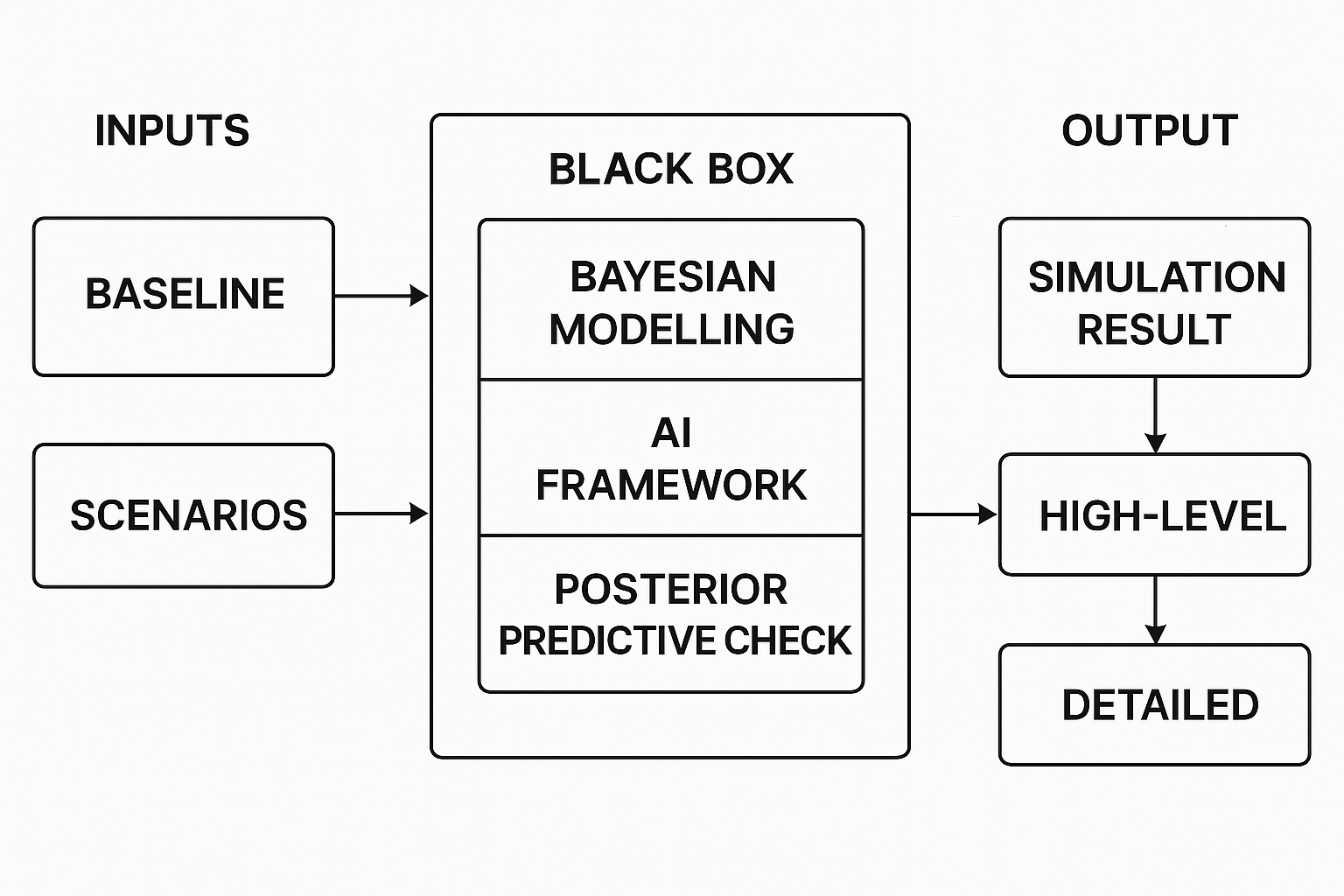
Step 1 – Inputs
Simulations start with two distinct input streams:
1. Baseline Inputs
The baseline represents the reference scenario for comparison. It contains historical data covering one year from the simulation date range.
This includes:
- Media spend
- Pricing
- Promotions
- Competitor activity
- Brand equity or awareness scores
- External factors such as inflation, consumer sentiment, or weather
If actual data is missing, the system generates forecasted equivalents using historical patterns and domain-specific logic.
2. Scenario Inputs
- The changes you apply to the baseline to create a “what-if” scenario.
- Can be entered as absolute changes (e.g., +£50,000 TV spend) or percentages (e.g., −10% digital spend).
- Examples:
- Increasing total media budget
- Redistributing spend between channels
- Adjusting prices or promotions
- Modifying competitor spend (if supported by the model)
How It Works Together: The Baseline Inputs represent business-as-usual. The Scenario Inputs apply your changes. Both are fed into the Modelling Engine which runs twice, once with the baseline and once with your scenario changes and then compares the results to show the impact.
Step 2 – The Modelling Engine
From the outside, the simulation model is like a black box: you provide the inputs, and it returns results. Inside, several processes work together to turn your “what-if” scenario into meaningful numbers.
Analogy:
Think of it like a flight simulator for marketing decisions:
- Your controls = the baseline data plus your adjustments (e.g., more spend on TV, lower price).
- The simulator’s software = the modelling engine, which uses past campaign data and statistical rules to project how your business will respond.
1. Bayesian Modelling
- The Bayesian approach is a statistical method that combines:
- What the model already “knows” from baseline data.
- The new scenario you’ve defined.
- It’s like asking a weather forecaster:
“Given all the weather patterns you’ve seen before, and knowing what conditions I’m giving you now, what’s the most likely weather tomorrow?”
- In practice:
- If you increase TV spend by 20%, the Bayesian model looks back at all previous situations where TV spend increased and estimates the likely sales impact - adjusting for other factors like seasonality or competitor activity.
- It also accounts for uncertainty. Instead of a single “this will definitely happen” value, it works with ranges of plausible outcomes, then presents the most likely figure for the report.
1.1 Use of Stan for Model Estimation:
The simulation engine uses Stan, an open-source platform for statistical modelling and high-performance computation (https://mc-stan.org/).
Stan enables efficient estimation of complex Bayesian models, allowing the system to handle large datasets and apply advanced statistical techniques to generate credible forecasts.
Underlying Model Equation:
At its core, the model estimates KPI outcomes as a weighted sum of media and other drivers, after transforming the inputs to account for advertising dynamics such as adstock (carryover) and saturation (diminishing returns).
In simplified mathematical form:
y_t = β1 * saturate(adstock(media1_t), λ1, γ1) + β2 * saturate(adstock(media2_t), λ2, γ2) + ...
Where:
y_t= predicted outcome (e.g., sales) at timetβi= effect size (impact weight) for media channeliadstock= models the lingering impact of past spendλi= adstock decay rate for channelisaturate= models diminishing returns at high spend levelsγi= saturation curve shape parameter for channeli
This structure ensures the model captures both the timing and scale of advertising effects.
2. AI Framework
Historical data is rarely complete, and future periods do not yet have actuals. The AI framework ensures simulations remain usable and realistic by:
- Filling gaps in historical data (e.g., missing competitor spend, pricing, or media efficiency values).
- Forecasting values outside the modelling period, which includes:
- The simulation period itself (often a future period).
- The padding period before and after the simulation range, which is used to capture carryover and lag effects.
Example:
Suppose your historical records contain no example of spending £50,000 in one week on social media. The AI framework analyses related scenarios (e.g., £40,000 and £60,000 spend weeks, seasonal patterns, competitor activity levels) and infers what is likely to happen with £50,000.
This enables simulations to handle new spend levels within existing channels.
Limitation: The framework cannot model entirely new channels with no historical presence, as the system requires at least some observed data to estimate effects.
3. Posterior Predictive Check (PPC)
- PPC is a validation test used to make sure the model’s predictions are realistic.
- “Posterior” means the model has already learned from past data and updated its internal view.
- “Predictive check” means it then tests its own predictions against patterns it knows to be realistic.
The PPC process in simulations is an out-of-sample test, meaning the model is evaluated on data that was not used when fitting it.
- This ensures the model can generalise beyond past data and avoids “overfitting”.
- In practice, it tests whether predictions remain realistic for situations the model has never directly “seen” before.
Analogy: It’s like training a student for an exam, then testing them with new questions to confirm they truly understand the material, not just memorised answers.
In marketing terms: If the model predicts that doubling TV spend will triple sales overnight, the PPC test will flag this as unlikely based on the historical relationship between spend and sales. This helps prevent wild, implausible results from being shown in the simulation output.
4. The To-Net Factor
One specific variable that plays a large role in simulations is media reach efficiency, measured as the To-Net Factor.
The To-Net Factor serves two purposes in the simulation:
Media Efficiency Measure
- Indicates how much ad exposure you get for a given spend.
- Lower To-Net Factor → more impressions per unit cost (higher efficiency).
- Higher To-Net Factor → fewer impressions per unit cost (lower efficiency).
Currency-to-Exposure Conversion
- The simulation model works in exposures (impressions) rather than just spend values.
- To do this, it converts media spend (in £, $, €) into impressions using the To-Net Factor:
Impressions = Media Spend ÷ To-Net Factor
This means:
- If the To-Net Factor is forecasted higher than historical, the model assumes fewer impressions are delivered for the same spend.
- If it’s forecasted lower, the model assumes more impressions are delivered.
Example:
- Historical To-Net Factor: 0.002 (£2 CPM) £10,000 spend → 5,000,000 impressions.
- Forecasted To-Net Factor: 0.0042 (£4.20 CPM) £10,000 spend → ~2,380,000 impressions.
Even with identical spend, the model predicts different exposures, which directly changes the simulated effect.
You can learn more about To-Net factor here- To-Net Factor
Step 3 – Output Generation
The model outputs a new scenario result, showing the expected change compared to the baseline.
You can choose between:
A. High-Level Report (Fast Simulation)
- Provides aggregated KPI-level results, such as total sales change.
- Results are split between media and non-media contributions, giving a clear view of how much of the projected outcome is driven by marketing activity versus other factors.
- Runs quickly, making it ideal for fast scenario checks and directional insights.
B. Detailed Report (Full Simulation)
- Breaks results down by channel, publisher, or campaign type.
- More processing for deeper analysis and planning.
Note: At times the Simulation Results May Differ from Business Insights (BI). Even for the same date range, results may differ, learn more about it here- Why Is My Simulation Baseline Different from Business Insights?
3. An Example
Baseline Inputs:
- £100,000 total media spend in January
- To-Net Factor = 0.002 (5,000,000 impressions)
- Competitor spend = £40,000
- Pricing and promotions unchanged
Scenario Inputs:
- Increase TV spend by £20,000
- Reduce digital spend by £10,000
Inside the Modelling Engine:
- Bayesian model reviews past patterns of similar changes.
- AI framework fills missing competitor spend data and estimates To-Net Factor for digital.
- PPC checks realism of the projected uplift.
- To-Net Factor conversion:
- TV: £70,000 ÷ 0.002 = 35,000,000 impressions
- Digital: £30,000 ÷ 0.0042 ≈ 7,140,000 impressions
- Total exposures are then fed into the model to calculate impact.
Outputs:
- High-Level: +2% projected sales uplift overall
- Detailed: +3% from TV, −1% from digital, small positive halo on other channels
4. Data Considerations
While the simulation engine is designed to provide realistic and actionable forecasts, its accuracy depends on the quality and completeness of the underlying data.
The following limitations should be considered when interpreting results:
1. Data Availability
The simulation engine generally works with complete historical datasets, so missing past data is not a major concern.
The main challenge lies in periods where no actual data yet exists, such as:
- The simulation period itself (often in the future).
- The padding periods before and after the simulation window, which are used to capture carryover and lag effects.
In these cases, the system generates forecasted values based on historical patterns and domain-specific logic. While these forecasts allow the simulation to run, they may not perfectly mirror what will happen in reality.
Example: If competitor spend data is not yet available for the upcoming quarter, the simulation uses past averages or seasonal trends to estimate it. This may slightly overstate or understate the actual market pressure when the period arrives.
2. Historical Coverage
Simulations rely on patterns that the model has learned from historical data.
This means the system can project outcomes for future scenarios and new spend levels within existing channels, but it cannot simulate entirely new channels that have no historical presence in the dataset.
Limitation: If you attempt to model a brand-new channel that has never been tracked, the simulation cannot estimate its effect.
3. Media Efficiency Assumptions
The To-Net Factor (media reach efficiency) is forecasted using historical data when future values are required.
If forecasts differ from reality, impression counts and therefore the predicted impact may be higher or lower than what ultimately happens.
In technical terms, the platform uses an exponential smoothing technique. This approach gradually reduces the influence of recent fluctuations and, for periods far into the future, converges towards the mean historical value observed.
4. External Factors
- External influences like sudden market disruptions, competitor strategy changes, or economic shifts are not automatically known to the model unless represented in the input data.
5. Seasonal Week Alignment
- Simulations align data by seasonal week patterns, not calendar dates.
- While this preserves seasonality, it can cause slight mismatches when comparing to calendar-based reports (e.g., BI module).
6. Model Assumptions
- The Bayesian and AI frameworks assume that historical relationships between drivers (e.g., spend, price) and outcomes will continue into the simulated period.
- Significant structural changes in the market may reduce accuracy.